Data Loss Prevention Statistics

In this article, we’ve collated 40 separate data loss prevention statistics covering DLP adoption, effectiveness, data leaks, generative AI, false positives, and security spending.
All of the figures here come from research published in 2025 and 2026 (so they are relevant to 2026 and 2027). These include data from surveys by the Cloud Security Alliance, Fortinet, Proofpoint and PwC.
- Drowning in DLP alert noise? Legion Security separates real exfiltration from false positives, establish who did what and why, then revoke access, quarantine data, or close the exposure. Learn more.
Our aim here is to help you understand the DLP market and benchmark the effectiveness of your DLP efforts. The statistics also show why DLP is very important. For example, the first stat below (from the CSA) shows that the vast majority of organizations have experienced a data loss incident recently.
As anyone familiar with how data flows in and out of organizations will know, this is obviously just the tip of the iceberg. Our opinion is that it would be impossible to find an organization that has not experienced a data loss incident if you look closely.
DLP effectiveness and adoption statistics
Data loss is everywhere, but DLP is not.
- 73% of organizations in a Cloud Security Alliance (CSA) survey experienced at least one confirmed data loss incident in the previous 24 months. [1]
- 16% of organizations that experienced data loss said DLP blocked their most significant incident before the data left the organization. [2]
- One-third of CISOs said their data remained inadequately protected, even with widespread adoption of DLP tools. [3]
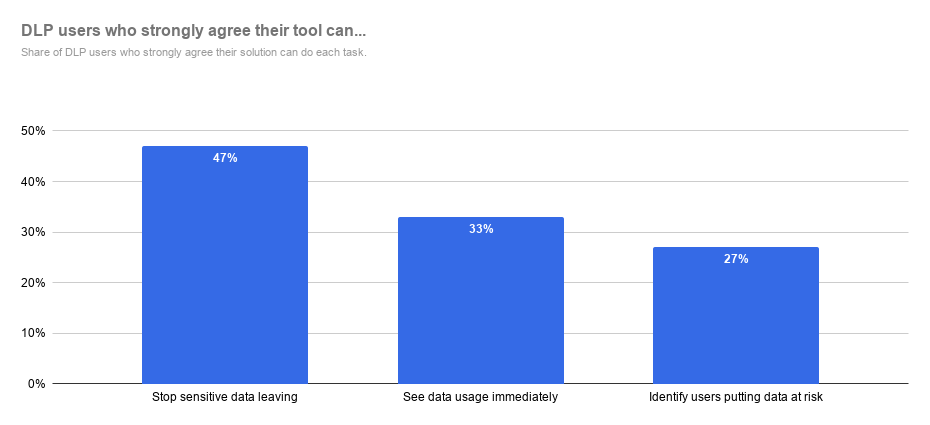
- 47% of security professionals using DLP strongly agreed that their existing solution was effective at stopping sensitive data from leaving the organization. [4]
- 33% of DLP users strongly agreed that their solution gave them immediate visibility into data usage. [4]
- 27% of DLP users strongly agreed that they could identify which employees or users were putting sensitive data at risk. [4]
- 47% of organizations used legacy DLP tools to monitor insider activity. [4]
- 48% of organizations had fully implemented DLP across key channels where data can leave the business. [5]
- 49% of organizations had fully implemented data classification policies. [5]
- 56% of respondents said data loss prevention was a needed feature in mission-critical collaboration platforms. [6]
Data loss prevention and AI statistics
DLP is getting harder due to AI, but AI is also being used in DLP with mixed results.
- 48% of security teams ranked generative AI among their top data exfiltration risks. [1]
- 29% of security teams could routinely produce a 30-day report showing sensitive data sent to generative AI tools. [2]
- 22% of organizations strictly blocked data exfiltration through generative AI tools. [1]
- 45% of organizations used DLP to control data sent to generative AI apps at the end of 2024, up from 42% in the summer of 2024. [7]
- 64% of telecommunications organizations used DLP for generative AI, the highest adoption rate of the industries measured by Netskope. [7]
- 42% of business administrators had no technical controls governing employee access to AI tools, including allow lists, block lists, or DLP rules. [8]
- Nearly 170 AI tools were used by the average organization observed across Jazz's customer environments, with fewer than 10 sanctioned. This is a vendor observation, not a finding from the CSA's survey sample. [1]
- Third most common: Shadow AI became the third most common non-malicious insider action detected in Verizon's DLP datasets in 2025, rising fourfold in percentage from 2024. [9]
- 35% of organizations had a written policy stating what employees should not enter into AI prompts, but lacked technical enforcement of that policy. [10]
- 32% of organizations could detect or monitor employees sharing proprietary design, creative, or marketing content, but could not consistently prevent it. [10]
- 20% of organizations relied mainly on written policies or training to control employee sharing of proprietary design, creative, or marketing content. [10]
Data exfiltration channels and DLP controls
An interesting disconnect here is that nearly half of organizations see cloud uploads as a risk, yet only a minority actually block uploads to cloud storage.
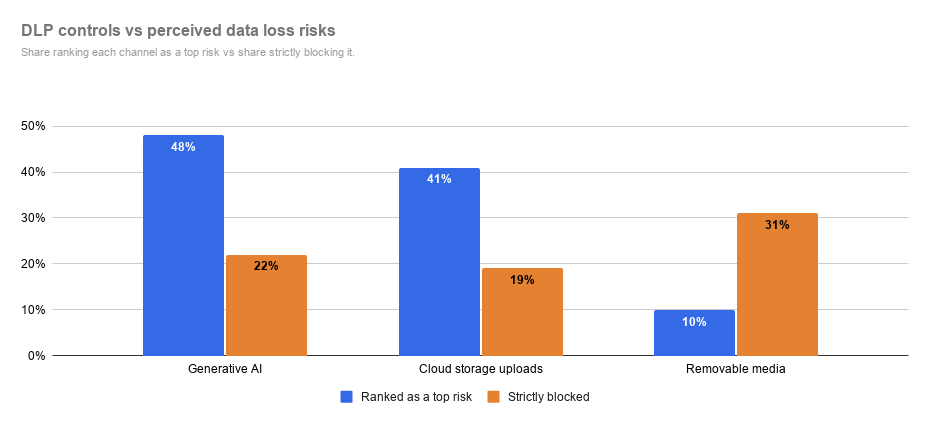
- 41% of security teams cited uploads to cloud storage as a top data exfiltration risk. [1]
- 19% of organizations strictly blocked cloud storage uploads. [1]
- 66% of organizations used DLP to restrict sensitive data being sent to personal apps. [7]
- 10% of security teams ranked removable media as a top exfiltration risk, the lowest-ranked channel in the CSA survey. [1]
- 31% of organizations strictly blocked removable media, a higher rate than for generative AI or cloud storage uploads in the same survey. [1]
DLP false positives, alert fatigue and enforcement
False positives and alert noise are a massive issue for DLP.
- 54% of security teams triaged DLP alerts where most alerts turned out to be false positives. [1]
- 90% of security teams reported at least one measurable impact from DLP alert fatigue in the previous year. [1]
- 21% of security teams reported voluntary staff departures directly attributed to the burden of DLP alerts. [1]
- More than 400 hours per year were spent by the average enterprise managing false-positive alerts from DLP or email security tools, according to a survey of security and IT leaders. [11]
- 71% of organizations said their security teams faced pushback against DLP enforcement during the previous two years. [1]
- 54% of organizations softened DLP enforcement in some form. [1]
- 66% of teams that faced enforcement pushback reduced DLP enforcement for particular teams or use cases. [1]
- 8% of teams that faced enforcement pushback reduced DLP enforcement across the wider organization. [1]
- 3% of teams that faced enforcement pushback reduced or paused their DLP program entirely. [1]
DLP investment and security priorities
Security leaders want more up-to-date analytics from their DLP solutions.
- 66% of security leaders prioritized real-time behavioral analytics in a next-generation DLP or insider-risk solution. [4]
- 61% of security leaders wanted immediate, day-one data visibility across environments from a next-generation solution. [4]
- 52% of security leaders prioritized controls for shadow AI and SaaS applications in their next-generation DLP or insider-risk tools. [4]
- 47% of IT decision-makers viewed phishing and malware as top threats to their data, but just 20% prioritized outbound email risks. [12]
- 39% of IT leaders prioritized human error prevention or DLP in their email security investments. [12]
About these statistics
The figures above come from separate studies with different populations, dates, and definitions of DLP. Several sources are vendor-commissioned, and some measure security professionals' survey responses rather than observed technical outcomes.
The CSA's DLP in the AI Era study surveyed 433 IT and security professionals in June and July 2026, mostly in the US and Canada. Fortinet's 2025 Insider Risk Report surveyed IT and cybersecurity professionals. PwC's 2027 Global Digital Trust Insights gathered responses from 3,934 leaders in 71 countries during 2026. The Netskope figures describe activity and controls observed in its customer environment during 2024 and reported in 2025.
Sources
- Cloud Security Alliance, DLP survey findings (2026)
- Cloud Security Alliance, DLP in the AI Era Survey Report (2026)
- Proofpoint, 2025 Voice of the CISO Report
- Fortinet, 2025 Insider Risk Report
- PwC, 2027 Global Digital Trust Insights (published 2026)
- Mattermost and Ponemon Institute (2025)
- Netskope, Cloud and Threat Report: 2025
- LastPass, State of AI and SaaS Security 2026
- Verizon, 2026 Data Breach Investigations Report
- BlackFog, research on sensitive data exposure through AI tools (2026)
- Abnormal AI, misdirected email prevention survey (2025)
- Zivver, Email Security Trends 2025